
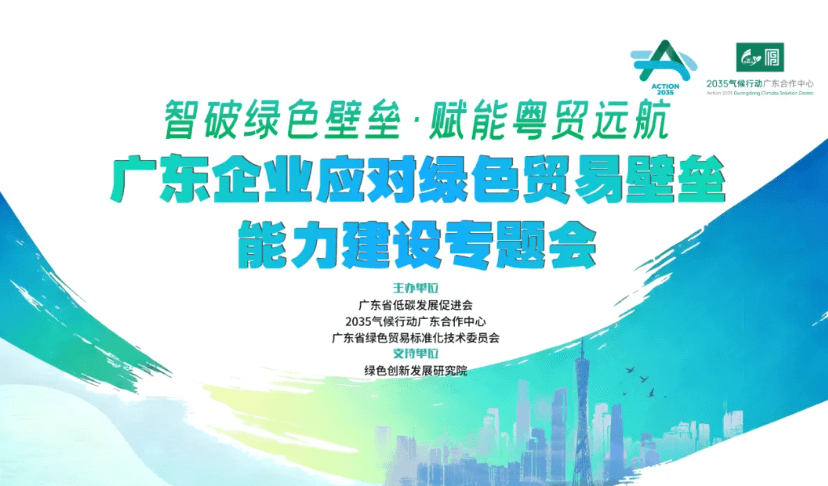
Workshop on Building Guangdong Enterprises’ Capacity to Address Green Trade Barriers
About This Event
To support Guangdong enterprises in navigating international green policies, enhancing compliance capabilities, and seizing early-mover advantages in the green transition, the Guangdong Low-Carbon Development Promotion Association, jointly with the Guangdong Technical Committee on Green Trade Standardization, hosted the "Workshop on Building Guangdong Enterprises’ Capacity to Address Green Trade Barriers" on October 22. The workshop brought together over 50 experts from certification bodies, research institutions, industry associations, and enterprises to discuss key topics including EU green regulations, carbon footprint accounting, battery legislation, ESG disclosure, and compliance with recycled content requirements. The workshop aimed to strengthen Guangdong companies’ readiness and resilience against emerging international green trade barriers. This session was part of a series of initiatives under the ACTION 2035 Climate Solution Guangdong Center to promote green and low-carbon development in Guangdong Province. iGDP Senior Analyst Liu Xueye delivered a presentation titled "The Long-Term Impact of the Carbon Border Adjustment Mechanism (CBAM) on China’s Steel Industry: A Quantitative Analysis." The analysis identified EU carbon prices as the most influential factor of CBAM costs. However, it also demonstrated that reductions in the carbon intensity of Chinese steel products—driven by higher shares of green power, adoption of electric arc furnace (EAF) technology, and broader deployment of low-carbon production processes—can significantly lower compliance liabilities under CBAM. A key finding highlighted that if the EU shifts its benchmark for free allowances from a process-based to a product-specific approach, integrated steel producers (using blast furnaces) could face a potential doubling of CBAM costs, while EAF-based producers may gain a competitive advantage.
Event Details
- Total Participants: 50+